
Keywords
Husbands
Wives
How to Cite
Abstract
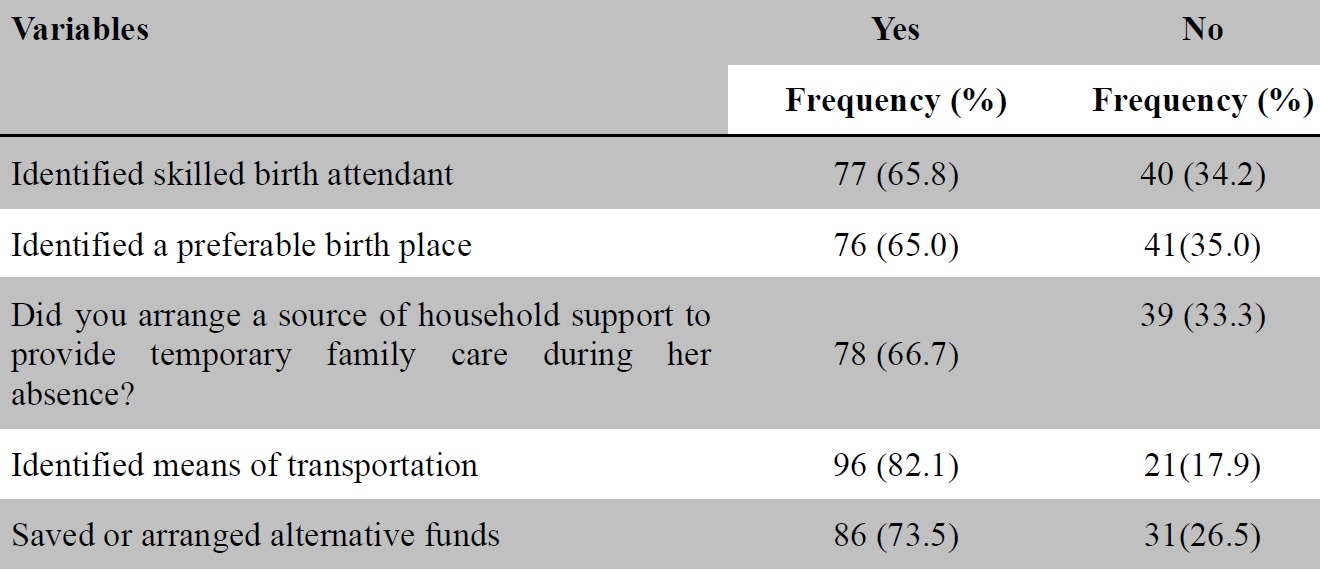
Introduction: Birth preparedness and complication readiness (BPCR) is an essential element of the antenatal care package which promotes pregnant women and their families to effectively plan for normal births and prepares them for any complications that may arise. This study aimed to explore the husbands’ preparedness and their knowledge level of BPCR. Methods: A descriptive cross-sectional study was conducted among 117 husbands whose wives delivered within the last 12 months in the out-patient and in-patient wards of the Obstetrics and Pediatrics departments of a medical college. The data were collected from August to December 2021 using a non-probability purposive sampling technique and a pre-tested semi-structured interview questionnaire. The statistical analysis was made at 95% confidence level. The data were summarized and described using descriptive statistics such as proportion, percentage, ratios, frequency distribution, mean and standard deviation. Results: None of the respondents knew all the three key danger signs of the postpartum period. More than three-quarters (78.6%) of the husbands were prepared in the BPCR component. Conclusion: Few husbands knew all the key danger signs during pregnancy, labor, postpartum and newborn periods. Slightly more than three-quarters of husbands were prepared well for birth and complication readiness. Individual components of BPCR was also poor among the respondents.
References
Silwal K, Poudyal JK, Shah R, Parajuli S, Basaula Y, Munikar S, et al. Factors Influencing Birth Preparedness in Rapti Municipality of Chitwan, Nepal. International Journal of Pediatrics. 2020;2020:PMID7402163 DOI: https://doi.org/10.1155/2020/7402163
Bhusal CK, Bhattarai S. Social Factors Associated with Involvement of Husband in Birth Preparedness Plan and Complication Readiness in Dang District, Nepal. Journal of Community Medicine & Health Education. 2018;08(636 ISSN: 2161-0711DOI: 10.4172/2161-0711.1000636
Solnes Miltenburg A, Roggeveen Y, van Roosmalen J, Smith H. Factors influencing implementation of interventions to promote birth preparedness and complication readiness. BMC Pregnancy and Childbirth. 2017;17(1):270. DOI: DOI 10.1186/s12884-017-1448-8
JHPIEGO (2004) Monitoring birth preparedness and complication readiness: tools and indicators for maternal and newborn health. BaltimoreMD: JHPIEGO. pp 1–19. DOI: https://www.healthynewbornnetwork.org/resource/monitoring-birth-preparedness-and-complication-readiness-tools-and-indicators-for-maternal-and-newborn-health/
Affipunguh PK, Laar AS. Assessment of knowledge and practice towards birth preparedness and complication readiness among women in Northern Ghana: a cross-sectional study. 2016. 2016;2(6):9. DOI: http://dx.doi.org/10.18203/issn.2454-2156.IntJSciRep
Markos D, Bogale D. Birth preparedness and complication readiness among women of child bearing age group in Goba woreda, Oromia region, Ethiopia. BMC Pregnancy and Childbirth. 2014;14(1):282. DOI: https;//doi.org/10.1186/1471-2393-14-282
Baraki Z, Wendem F, Gerensea H, Teklay H. Husbands involvement in birth preparedness and complication readiness in Axum town, Tigray region, Ethiopia, 2017. BMC Pregnancy and Childbirth. 2019;19(1):180.PMID:31117972 DOI: 10.1186/s12884-019-2338-z
Wai KM, Shibanuma A, Oo NN, Fillman TJ, Saw YM, Jimba M. Are Husbands Involving in Their Spouses' Utilization of Maternal Care Services?: A Cross-Sectional Study in Yangon, Myanmar. PloS one. 2015;10(12):e0144135.DOI:10.1371/journal.pone.0144135
Mersha AG. Male involvement in the maternal health care system: implication towards decreasing the high burden of maternal mortality. BMC Pregnancy and Childbirth. 2018;18(1):493.PMID: 30547771DOI: 10.1186/s12884-018-2139-9
Kahsay Woldegebriel, Gidey Gebreamlak, Haftom G. Assessment of Husbands’ Participation on Birth Preparedness and Complication Readiness in Enderta Woreda, Tigray Region, Ethiopia, 2012. Journal of Women's Health Care. 2013;03. ISSN:: 2167-0420 DOI:http://dx.doi.org/10.4172/2167-0420.1000140
Mahendra G, AfraFarheen MV, Vijayalakshmi S. Husband’s participation in birth preparedness and complication readiness. Obs Gyne Review: Journal of Obstetric and Gynecology. 2018;4(4). DOI: https://doi.org/10.17511/joog.2018.i04.05
Thapa DK, Niehof A. Women's autonomy and husbands' involvement in maternal health care in Nepal. Social science and medicine (1982). 2013;93:1-10. PMID:23906115 DOI:https://doi.org/10.1016/j.socscimed.2013.06.003
Mullany BC. Barriers to and attitudes towards promoting husbands' involvement in maternal health in Katmandu, Nepal. Social science & medicine (1982). 2006;62(11):2798-809.
Ijang YP, Cumber SNN, Nkfusai CN, Venyuy MA, Bede F, Tebeu PM. Awareness and practice of birth preparedness and complication readiness among pregnant women in the Bamenda Health District, Cameroon. BMC Pregnancy and Childbirth. 2019;19(1):371.DOI:https://doi.org/10.1186/s12884-019-2511-4
- The Journal of Lumbini Medical College (JLMC) publishes open access articles under the terms of the Creative Commons Attribution (CC BY) License which permits use, distribution and reproduction in any medium, provided the original work is properly cited.
- JLMC requires an exclusive license to publish the article first in its journal in print and online.
- The corresponding author should read and agree to the following statement before submission of the manuscript for publication,
- License agreement
- In submitting an article to Journal of Lumbini Medical College (JLMC) I certify that:
- I am authorized by my co-authors to enter into these arrangements.
- I warrant, on behalf of myself and my co-authors, that:
- the article is original, has not been formally published in any other peer-reviewed journal, is not under consideration by any other journal and does not infringe any existing copyright or any other third-party rights;
- I am/we are the sole author(s) of the article and have full authority to enter into this agreement and in granting rights to JLMC are not in breach of any other obligation;
- the article contains nothing that is unlawful, libelous, or which would, if published, constitute a breach of contract or of confidence or of commitment given to secrecy;
- I/we have taken due care to ensure the integrity of the article. To my/our - and currently accepted scientific - knowledge all statements contained in it purporting to be facts are true and any formula or instruction contained in the article will not, if followed accurately, cause any injury, illness or damage to the user.
- I, and all co-authors, agree that the article, if editorially accepted for publication, shall be licensed under the Creative Commons Attribution License 4.0. If the law requires that the article be published in the public domain, I/we will notify JLMC at the time of submission, and in such cases the article shall be released under the Creative Commons 1.0 Public Domain Dedication waiver. For the avoidance of doubt it is stated that sections 1 and 2 of this license agreement shall apply and prevail regardless of whether the article is published under Creative Commons Attribution License 4.0 or the Creative Commons 1.0 Public Domain Dedication waiver.
- I, and all co-authors, agree that, if the article is editorially accepted for publication in JLMC, data included in the article shall be made available under the Creative Commons 1.0 Public Domain Dedication waiver, unless otherwise stated. For the avoidance of doubt it is stated that sections 1, 2, and 3 of this license agreement shall apply and prevail.
Please visit Creative Commons web page for details of the terms.