
Keywords
Doppler
Histopathology
Ovarian mass
How to Cite
Abstract
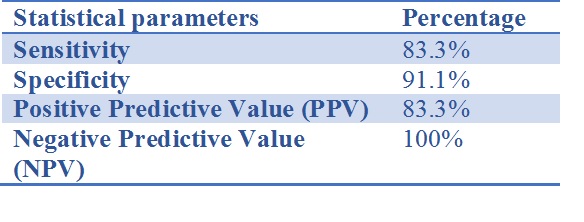
Introduction: Ovarian cancer is the fifth most common cancer in Nepalese females and the tenth overall, accounting for 5% of the total new cases of cancer in females in 2020. Ultrasonography (USG) remains the primary tool for the diagnosis and characterization of ovarian masses in which many grey-scale and Doppler characteristics are evaluated. Various scoring systems have been described incorporating different USG parameters to differentiate the benign and malignant nature of ovarian masses. Alcazar scoring system includes both grey-scale as well as Doppler characteristics of the ovarian masses and is one of the more widely used systems worldwide. Methods: This was an observational cross-sectional study based on 52 consecutive patients who were clinically suspected to have ovarian mass and referred for USG evaluation and who subsequently underwent surgery.Results:As confirmed by histopathology, 37 cases were benign and 15 were malignant masses. Alcazar system of scoring identified 34 out of 37 benign cases and 15 out of 15 malignant cases with sensitivity and specificity for diagnosing malignant cases of 83.3% and 91.1% respectively. Conclusion: Alcazar system of scoring is a highly effective tool to differentiate between benign and malignant ovarian masses and can be of great help in diagnosis, characterization and effective preoperative planning.
References
International Agency for Research on Cancer. Nepal: Globocan 2020 [Internet]. Geneva: WHO; 2021. [cited 4 Nov 2021]. Available from: https://gco.iarc.fr/today/data/factsheets/populations/524-nepal-fact-sheets.pdf
American Cancer Society Medical and Editorial Content Team. About Ovarian Cancer [Internet]. Atlanta, Georgia: American Cancer Society; 2018. [cited 6 Nov 2021]. Available from: https://www.cancer.org/cancer/ovarian-cancer/about/key-statistics.html
Alcázar JL, Mercé LT, Laparte C, Jurado M, López-GarcÃa G. A new scoring system to differentiate benign from malignant adnexal masses. Am J Obstet Gynecol. 2003;188(3):685-92.PMID: 12634641 DOI: https://doi.org/10.1067/mob.2003.176
DePriest PD, Shenson D, Fried A, Hunter JE, Andrews SJ, Gallion HH, et al. A morphology index based on sonographic findings in ovarian cancer. Gynecol Oncol. 1993;51(1):7-11.PMID: 8244178 DOI: https://doi.org/10.1006/gyno.1993.1238
Sassone AM, Timor-Tritsch IE, Artner A, Westhoff C, Warren WB. Transvaginal sonographic characterization of ovarian disease: evaluation of a new scoring system to predict ovarian malignancy. Obstet Gynecol. 1991;78(1):70-6.PMID: 2047071
Ferrazzi E, Zanetta G, Dordoni D, Berlanda N, Mezzopane R, Lissoni AA, et al. Transvaginal ultrasonographic characterization of ovarian masses: comparison of five scoring systems in a multicenter study. Ultrasound in Obstetrics & Gynecology. 1997;10(3):192-7. Available from:https://obgyn.onlinelibrary.wiley.com/doi/abs/10.1046/j.1469-0705.1997.10030192.x
Zhang X, Meng X, Dou T, Sun H. Diagnostic accuracy of transvaginal ultrasound examination for assigning a specific diagnosis to adnexal masses: A meta-analysis. ExpTher Med. 2020;20(6):265. PMID: 33199990 DOI: https://doi.org/10.3892/etm.2020.9395
Desai D, Desai VA, Verma RN, Shrivastava A. Role of gray scale and color Doppler in differentiating benign from malignant ovarian masses. J Midlife Health. 2010;1(1):23-5.PMID: 21799634 DOI: https://doi.org/10.4103/0976-7800.66991
MahijaS, Hk N. Evaluation of the alcazar scoring system in differentiating benign from malignant ovarian tumors. International Journal of Reproduction, Contraception, Obstetrics and Gynecology. 2017;4(4):1004-7. DOI: https://dx.doi.org/10.18203/2320-1770.ijrcog20150415
Chaudhari SN, Deshpande PN, Gupta PR, Warty TR, Bhikane DB. Evaluation of the Scoring Systems to Differentiate between Benign and Malignant Adnexal Masses in a Tertiary Care Center, Pune. Journal of South Asian Federation of Obstetrics and Gynaecology. 2013;5(3):135-8. Available from: https://www.jsafog.com/doi/JSAFOG/pdf/10.5005/jp-journals-10006-1246
Hassen K, Ghossain MA, Rousset P, Sciot C, Hugol D, Baddoura R, et al. Characterization of papillary projections in benign versus borderline and malignant ovarian masses on conventional and color Doppler ultrasound. AJR Am J Roentgenol. 2011;196(6):1444-9.PMID: 21606312 DOI: https://doi.org/10.2214/ajr.10.5014
- The Journal of Lumbini Medical College (JLMC) publishes open access articles under the terms of the Creative Commons Attribution (CC BY) License which permits use, distribution and reproduction in any medium, provided the original work is properly cited.
- JLMC requires an exclusive license to publish the article first in its journal in print and online.
- The corresponding author should read and agree to the following statement before submission of the manuscript for publication,
- License agreement
- In submitting an article to Journal of Lumbini Medical College (JLMC) I certify that:
- I am authorized by my co-authors to enter into these arrangements.
- I warrant, on behalf of myself and my co-authors, that:
- the article is original, has not been formally published in any other peer-reviewed journal, is not under consideration by any other journal and does not infringe any existing copyright or any other third-party rights;
- I am/we are the sole author(s) of the article and have full authority to enter into this agreement and in granting rights to JLMC are not in breach of any other obligation;
- the article contains nothing that is unlawful, libelous, or which would, if published, constitute a breach of contract or of confidence or of commitment given to secrecy;
- I/we have taken due care to ensure the integrity of the article. To my/our - and currently accepted scientific - knowledge all statements contained in it purporting to be facts are true and any formula or instruction contained in the article will not, if followed accurately, cause any injury, illness or damage to the user.
- I, and all co-authors, agree that the article, if editorially accepted for publication, shall be licensed under the Creative Commons Attribution License 4.0. If the law requires that the article be published in the public domain, I/we will notify JLMC at the time of submission, and in such cases the article shall be released under the Creative Commons 1.0 Public Domain Dedication waiver. For the avoidance of doubt it is stated that sections 1 and 2 of this license agreement shall apply and prevail regardless of whether the article is published under Creative Commons Attribution License 4.0 or the Creative Commons 1.0 Public Domain Dedication waiver.
- I, and all co-authors, agree that, if the article is editorially accepted for publication in JLMC, data included in the article shall be made available under the Creative Commons 1.0 Public Domain Dedication waiver, unless otherwise stated. For the avoidance of doubt it is stated that sections 1, 2, and 3 of this license agreement shall apply and prevail.
Please visit Creative Commons web page for details of the terms.