
Keywords
High Level Gentamicin Resistance
Linezolid
Vancomycin Resistant Enterococci
How to Cite
Abstract
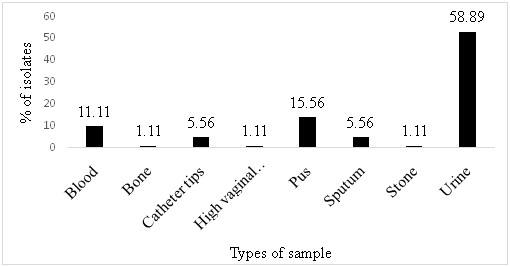
Introduction: Enterococcus species are Gram-positive oval cocci arranged in pairs or short chains. They are found as gut microbiota of adults, but from the last decade, they are emerging as causative agents of various nosocomial infections throughout the world. High level aminoglycoside resistance and vancomycin resistance are being increasingly reported from different parts of the world thus limiting the therapeutic options for the treatment of enterococcal infections. The objective of our study was to determine the antimicrobial susceptibility pattern of Enterococcus species isolated from various clinical specimens in Lumbini Medical College and Teaching Hospital, Palpa. Methods: All the clinical samples were cultured and enterococci isolates were tested for antibiotic sensitivity, high level gentamicin resistance and vancomycin resistance by Kirby Bauer disc diffusion method.Results: Among the 90 isolated Enterococcus spp.maximum isolates were obtained from the age group 21-40 years, most from in-patient department with urine as sample (n=53, 58.89%). The highest antimicrobial susceptibility was recorded for linezolid (90.48%) followed by chloramphenicol (79.71%), nitrofurantoin (76.83%) and then high-level gentamicin (70%). The overall prevalence of high level gentamicin resistance and vancomycin resistant enterococci were 30% and 35.55% respectively. Conclusion: The present findings show a high rate of high-level gentamicin and vancomycin resistant enterococci. Thus, routine surveillance of such resistance pattern should be done every year. Linezolid can be considered as a drug of choice to treat serious enterococcal infections.
References
Nalayini S. A Study of Prevalence of Vancomycin Resistance among the Enterococcus spp. Isolated from Various Clinical Samples in a Tertiary Care Hospital in Chennai [dissertation]. [Chennai, India]: The Tamilnadu Dr. M.G.R. Medical University;2013. 122p. Available from: http:/repository-tnmgrmu.ac.in/id/eprint/1676
Ghidán A. Epidemiology of vanA gene carrier entero- cocci : Molecular characterisation, antibiotic sensitivity and phylogenetic relationship of Hungarian isolates. [Ph.D. Thesis]. [Budapest]: Semmelweis University. 2007. 97p. Available from: http://old.semmelweis.hu/wp-content/phd/phd_live/vedes/export/ghidanagoston.d.pdf
Mukherjee K, Bhattacharjee D, Chakraborti G, Chatterjee SS. Prevalence and Antibiotic Susceptibility Pattern of Enterococcus Species from Various Clinical Samples in a Tertiary Care Hospital in Kolkata. International Journal of Contemporary Medical Research. 2016;3(6):1565-7. Available from: https://www.ijcmr.com/uploads/7/7/4/6/77464738/_ijcmr_607_v1_may_9.pdf
Hällgren A, Abednazari H, Ekdahl C, Hanberger H, Nilsson M, Samuelsson A, et al.Antimicrobial susceptibility patterns of enterococci in intensive care units in Sweden evaluated by different MIC breakpoint systems. J Antimicrob. Chemother. 2001;48(1): 53-62. PMID: 11418512DOI: https://doi.org/10.1093/jac/48.1.53
Adhikari RP, Shrestha S, Barakoti A, Rai JR, Amatya R. Antimicrobial Susceptibility Pattern of Enterococcus Species Isolated from Various Clinical Specimens in a Tertiary Care Hospital, Kathmandu, Nepal. Nepal Medical College Journal.2018;20(4):173-7. DOI: https://doi.org/10.3126/nmcj.v20i4.25142
Ghimire S, Basnet HB, Joshi LR, Sapkota M. Prevalence of Vancomycin Resistant Enterococci Species in Minced Buffalo Meat of Chitwan, Nepal. International Journal of Applied Sciences and Biotechnology. 2014;2(4):409-12. DOI: https://doi.org/10.3126/ijasbt.v2i4.11123
Wagner T. How to Be a Bad Bug: Virulence Determinants of Enterococcus faecium [Internet]. [Accessed on 14th October 2020]. Available from:https://munin.uit.no/handle/10037/14108
Zhong Z, Zhang W, Song Y, Liu W, Xu H, Xi X, et al. Comparative genomic analysis of the genus Enterococcus.Microbiol Res. 2017;196(0):95-105.PMID: 28164795 DOI: https://doi.org/10.1016/j.micres.2016.12.009
Karna A, Baral R, Khanal B. Characterization of clinical isolates of enterococci with special reference to glycopeptide susceptibility at a tertiary care center of eastern Nepal. International Journal of Microbiology. 2019;2019(0):7936156. DOI: https://doi.org/10.1155/2019/7936156
Getso MI, Sundaramoorthy S, Kanishka HD, Aliyu M, Yusuf I, Azeez-Akande O, et al. Distribution and antibiotics susceptibility patterns of Enterococcus spp. from a selected hospital in India. Journal of Sciences. 2020;4(3):1-9. DOI: https://www.researchgate.net/publication/344705138
Bhardwaj S, Bhamre K, Dhawale J, Patil M, Divase S. Enterococcus faecium and Enterococcus faecalis, the nosocomial pathogens with special reference to multi-drug resistance and phenotypic characterization. International Journal of Pharmaceutical Sciences and Practice. 2013;2(1):1-10. Available from: https://www.ripublication.com/ijpsp/ijpspv2n1_01.pdf
Pandey R, Mishra SK, Shrestha A. Characterisation of ESKAPE Pathogens with Special Reference to Multidrug Resistance and Biofilm Production in a Nepalese Hospital. Research Square. 2019;14(0):1-26. DOI:https://doi.org/10.21203/rs.2.18490/v1
Acharya KP, Wilson RT. Antimicrobial Resistance in Nepal. Frontiers in Medicine. 2019;6(0):7-9. DOI: https://doi.org/10.3389/fmed.2019.00105
Dahal RH, Chaudhary DK. Microbial Infections and Antimicrobial Resistance in Nepal: Current Trends and Recommendations. The Open Microbiology Journal. 2018;12(0):230-42. DOI: https://doi.org/10.2174/1874285801812010230
Jabbari SM, Shiadeh, Pormohammad A, Hashemi A, Lak P. Global prevalence of antibiotic resistance in blood-isolated enterococcus faecalis and enterococcus faecium: A systematic review and meta-analysis. Infection and Drug Resistance. 2019;2019(0):2713-25. DOI: https://doi.org/10.2147/IDR.S206084
Nepal HP, Khanal B, Acharya A. Characterization and antimicrobial resistance of clinical isolates of enterococcci in tertiary care hospital in eastern Nepal. 2013;11(1):17-22. DOI: http://dx.doi.org/10.3126/hren.v11i1.7595
HIMEDIA. Antimicrobial Susceptibility Systems [Internet].[Accessed on 7th July 2021]. Available from: https://www.himedialabs.com/HML/images/literature/pdf/100000027/68.pdf
Mittal S, Singla P, Deep A, Bala K, Sikka R, Garg M, et al. Vancomycin and High Level Aminoglycoside Resistance in Enterococcus spp. in a Tertiary Health Care Centre: A Therapeutic Concern. Journal of Pathogens. 2016;2016(0):8262561. DOI: https://doi.org/10.1155/2016/8262561
Srivastava P, Mehta R, Nirwan PS, Sharma M, Dahiya SS. Prevalence and Antimicrobial Susceptibility of Enterococcus Species Isolated from Different Clinical Samples in a Tertiary Care Hospital of North India. National Journal of Medical Research. 2013;3(4):389-91.Available from:https://www.bibliomed.org/mnsfulltext/78/78-1388846909.pdf?1638635674
Sreeja S, Babu PRS, Prathab AG. The prevalence and the characterization of the Enterococcus species from various clinical samples in a tertiary care hospital.J Clin Diagn Res. 2012;6(9):1486-8. PMID: 23285436 DOI:https://doi.org/10.7860/jcdr/2012/4560.2539
Yilema A, Moges F, Tadele S, Endris M, Kassu A, Abebe W, et al. Isolation of enterococci, their antimicrobial susceptibility patterns and associated factors among patients attending at the University of Gondar Teaching Hospital. BMC Infect Dis.2017;17(1):276. PMID: 28412932 DOI:https://doi.org/10.1186/s12879-017-2363-3
Shrestha LB, Baral R, Poudel P, Khanal B. Clinical, etiological and antimicrobial susceptibility profile of pediatric urinary tract infections in a tertiary care hospital of Nepal. BMC Pediatr. 2019;19(1):36.PMID: 30696410 DOI: https://doi.org/10.1186/s12887-019-1410-1
Cirak MY, Sultan N. Prevalence of High Level Aminoglycoside and Vancomycin Resistance among Enterococci in Turkey. Acta Microbiol Pol. 1998;47(3):267-73. PMID: 9990710
- The Journal of Lumbini Medical College (JLMC) publishes open access articles under the terms of the Creative Commons Attribution (CC BY) License which permits use, distribution and reproduction in any medium, provided the original work is properly cited.
- JLMC requires an exclusive license to publish the article first in its journal in print and online.
- The corresponding author should read and agree to the following statement before submission of the manuscript for publication,
- License agreement
- In submitting an article to Journal of Lumbini Medical College (JLMC) I certify that:
- I am authorized by my co-authors to enter into these arrangements.
- I warrant, on behalf of myself and my co-authors, that:
- the article is original, has not been formally published in any other peer-reviewed journal, is not under consideration by any other journal and does not infringe any existing copyright or any other third-party rights;
- I am/we are the sole author(s) of the article and have full authority to enter into this agreement and in granting rights to JLMC are not in breach of any other obligation;
- the article contains nothing that is unlawful, libelous, or which would, if published, constitute a breach of contract or of confidence or of commitment given to secrecy;
- I/we have taken due care to ensure the integrity of the article. To my/our - and currently accepted scientific - knowledge all statements contained in it purporting to be facts are true and any formula or instruction contained in the article will not, if followed accurately, cause any injury, illness or damage to the user.
- I, and all co-authors, agree that the article, if editorially accepted for publication, shall be licensed under the Creative Commons Attribution License 4.0. If the law requires that the article be published in the public domain, I/we will notify JLMC at the time of submission, and in such cases the article shall be released under the Creative Commons 1.0 Public Domain Dedication waiver. For the avoidance of doubt it is stated that sections 1 and 2 of this license agreement shall apply and prevail regardless of whether the article is published under Creative Commons Attribution License 4.0 or the Creative Commons 1.0 Public Domain Dedication waiver.
- I, and all co-authors, agree that, if the article is editorially accepted for publication in JLMC, data included in the article shall be made available under the Creative Commons 1.0 Public Domain Dedication waiver, unless otherwise stated. For the avoidance of doubt it is stated that sections 1, 2, and 3 of this license agreement shall apply and prevail.
Please visit Creative Commons web page for details of the terms.